
Short answer, in plain words. Plants eat light, so start with how much light they should eat, then work back to watts. For flower, aim for about 900 µmol/m²/s across the canopy. Multiply that by the canopy area, add a bit for light that misses the plants, and divide by how good your light is (its µmol/J). A 4 × 4 ft tent needs about 525 W of a top-tier LED, 605 W of a mid-tier one, 685 W of a budget panel, or about 925 W of double-ended HPS. Then hang it so the corners get nearly as much light as the middle, and check with a PAR meter. Supported (targets from controlled trials and the KB's PPFD article; the 85% canopy share is an assumption).
Use the calculator: lighting calculator. For why µmol/J matters, read LED vs HPS: the heat and power-bill myth; for checking a seller's numbers, the LED buyer-beware guide. This guide doesn't repeat them.
Part of the series: LED grow lights, properly. 1. LED vs HPS: the heat and power-bill myth · 2. Samsung LM301B vs LM301H, bins and fake chips · 3. LED drivers explained · 4. How much grow light your space needs (this guide)
What are the formulas?
All the math is three steps. Metric first, imperial alongside.
- Photons the canopy needs (µmol/s) = target PPFD (µmol/m²/s) × canopy area (m²). Area in m² = area in ft² × 0.0929.
- Photons the fixture must make (µmol/s, PPF) = step 1 ÷ canopy share. We assume 0.85: about 85% of the fixture's photons land on the canopy in a reflective tent. It's an assumption; real values depend on walls, hanging height and how far the canopy fills the floor.
- Wall watts (W) = step 2 ÷ fixture efficacy (µmol/J). Watts per ft² = wall watts ÷ ft².
Two handy shortcuts:
- PPFD from watts per ft²: PPFD ≈ W/ft² × µmol/J × 0.85 ÷ 0.0929 ≈ W/ft² × µmol/J × 9.15.
- DLI (mol/m²/day) = PPFD × hours × 0.0036 [6].
Fixture tiers used below: double-ended HPS 1.7 µmol/J (independent tests) [2], budget LED 2.3, mid-tier LED 2.6, top-tier LED 3.0 (about 6% of the DLC list reached 3.0 in early 2022) [3]. The DLC minimum is about 2.5 µmol/J since April 2025 [7]. Use your fixture's verified figure, not the box.
- PPFD targete.g. 900 µmol/m²/sFlower, ambient CO₂
- × canopy area1.49 m² in a 4 × 4
- ÷ 0.85Photons that miss the canopy (assumed)
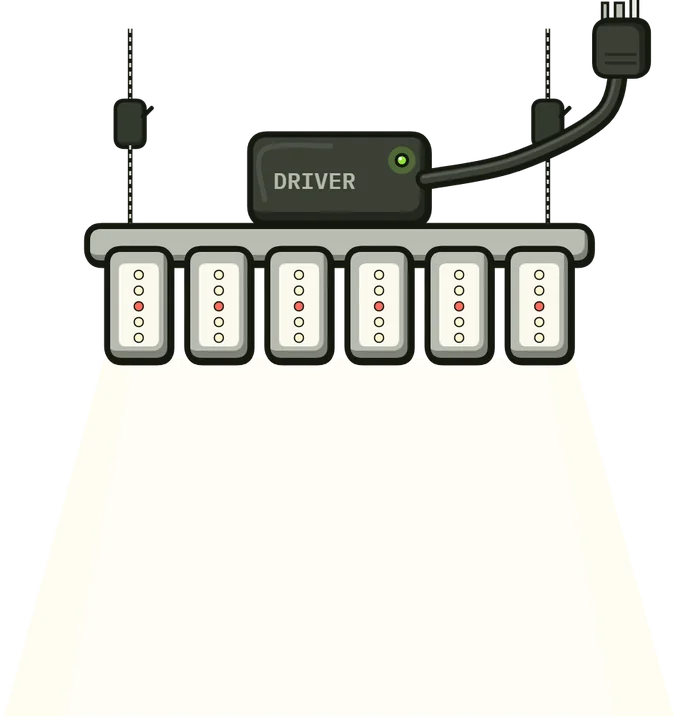
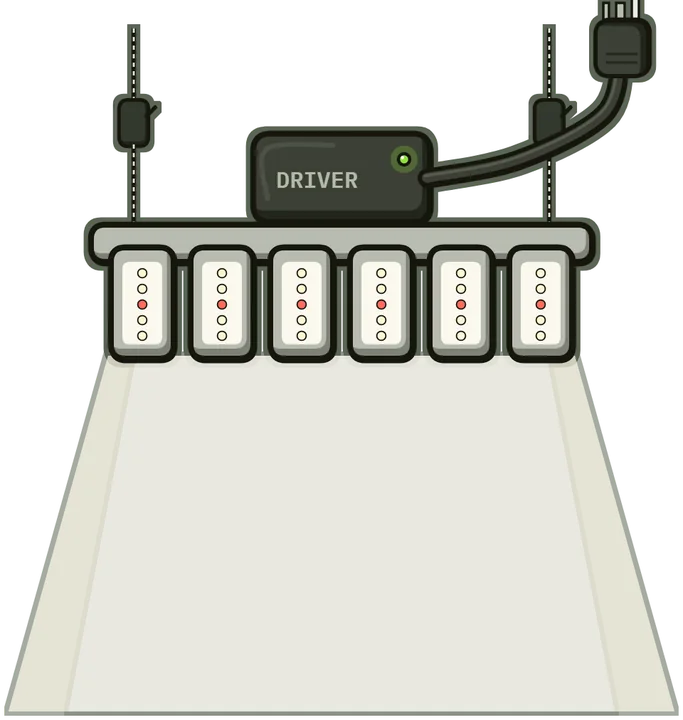 ÷ fixture µmol/JUse the verified figure
- Wall watts~605 W at 2.6 µmol/J
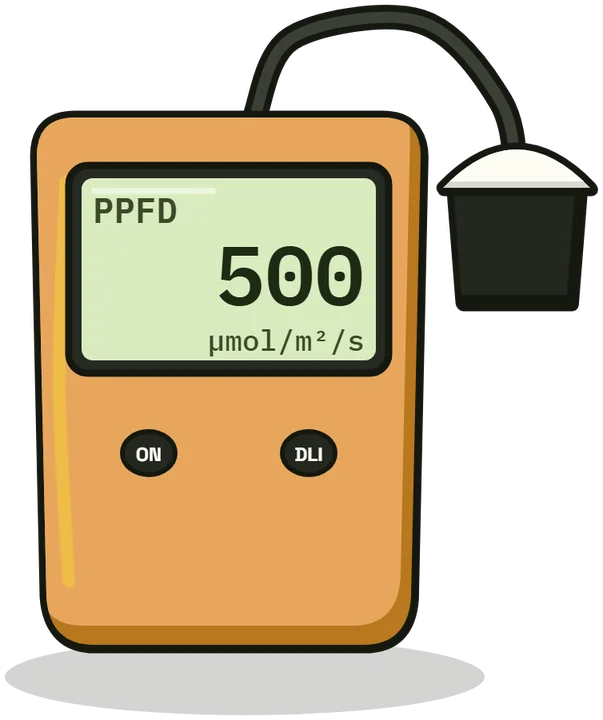
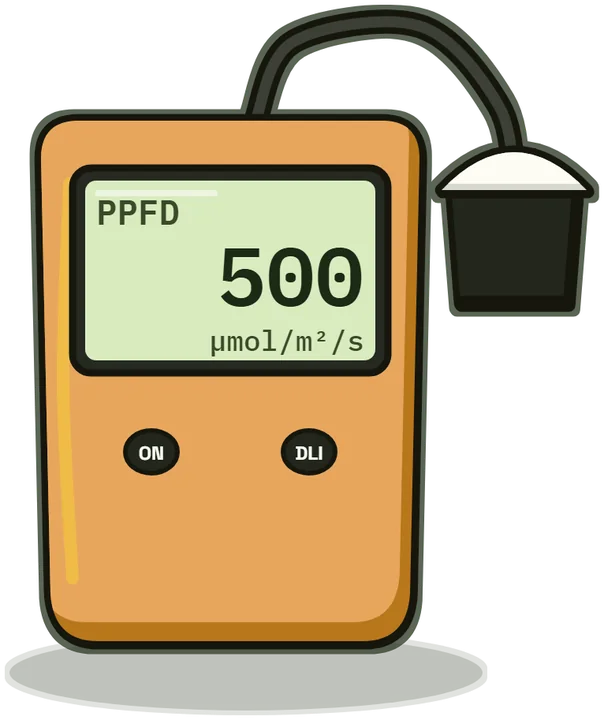 Measure and dimPAR meter at canopy height
Source: Formulas above; 4 × 4 example from the size table.
What PPFD and DLI should I aim for?
| Stage | PPFD (µmol/m²/s) | Hours | DLI (mol/m²/day) |
|---|---|---|---|
| Seedlings | 150–300 | 18 | 10–19 |
| Early veg | 300–500 | 18–24 | 19–43 |
| Late veg | 500–900 | 18 | 32–58 |
| Flower, ambient CO₂ | 800–1,200 | 12–13 | 35–56 |
| Flower, 900–1,200 ppm CO₂ | 1,000–1,500 | 12 | 43–65 |
These come from the GenetixBay PPFD and DLI by stage article, where each range has its own evidence label. In the best controlled trial, cannabis flower yield rose linearly from 120 to 1,800 µmol/m²/s at ambient CO₂ (116 to 519 g/m²), with no change in cannabinoid potency [1]. More light means more grams, until something else (heat, CO₂, roots, the electricity bill) becomes the limit.
How many watts for each tent size?
Flower at 900 µmol/m²/s, 85% canopy share. Wall watts, with watts per ft² in brackets.
| Space | Area | Photons needed (PPF) | DE HPS 1.7 | Budget LED 2.3 | Mid LED 2.6 | Top LED 3.0 |
|---|---|---|---|---|---|---|
| 2 × 4 ft tent | 8 ft² (0.74 m²) | ~790 µmol/s | ~465 W (58) | ~340 W (43) | ~305 W (38) | ~260 W (33) |
| 4 × 4 ft tent | 16 ft² (1.49 m²) | ~1,570 µmol/s | ~925 W (58) | ~685 W (43) | ~605 W (38) | ~525 W (33) |
| 5 × 5 ft tent | 25 ft² (2.32 m²) | ~2,460 µmol/s | ~1,445 W (58) | ~1,070 W (43) | ~945 W (38) | ~820 W (33) |
| 4 × 8 ft tent | 32 ft² (2.97 m²) | ~3,150 µmol/s | ~1,850 W (58) | ~1,370 W (43) | ~1,210 W (38) | ~1,050 W (33) |
| 10 × 10 ft room | 100 ft² (9.29 m²) | ~9,840 µmol/s | ~5,790 W (58) | ~4,280 W (43) | ~3,785 W (38) | ~3,280 W (33) |
For veg at about 600 µmol/m²/s, multiply by two-thirds: a top-tier LED needs about 22 W/ft² (175 W in a 2 × 4; 350 W in a 4 × 4). For CO₂-enriched flower at about 1,200, multiply by four-thirds: about 44 W/ft² of a top-tier LED (700 W in a 4 × 4).
Plain-words version: a better light needs fewer watts for the same plant food. A cheap light needs more watts, and more watts means more heat to get rid of.
- Top-tier LED, 3.0 µmol/J
- Mid-tier LED, 2.6 µmol/J
- Budget LED, 2.3 µmol/J
- Double-ended HPS, 1.7 µmol/J
PPFD ≈ W/ft² × µmol/J × 0.85 ÷ 0.0929; the 0.85 canopy share is an assumption.
Source: Computed with this guide's formula; efficacies [2][3]; flower band from the KB PPFD and DLI article.
Show the numbers
| Wall watts per square foot (W/ft²) | Top-tier LED, 3.0 µmol/J: Average canopy PPFD (µmol/m²/s) | Mid-tier LED, 2.6 µmol/J: Average canopy PPFD (µmol/m²/s) | Budget LED, 2.3 µmol/J: Average canopy PPFD (µmol/m²/s) | Double-ended HPS, 1.7 µmol/J: Average canopy PPFD (µmol/m²/s) |
|---|---|---|---|---|
| 0 | 0 | 0 | 0 | 0 |
| 60 | 1,647 | 1,427 | 1,262 | 933 |
How many fixtures, and which shape?
Number of fixtures = wall watts needed ÷ watts per fixture, rounded up. Then check that the fixtures' combined footprint covers the canopy.
Worked example, 4 × 8 ft tent in flower with a mid-tier LED (2.6 µmol/J): about 1,210 W needed. Two 600 W fixtures give 1,200 W (1% short; fine). Three 400 W bars would give 1,200 W with more even coverage. Run them at the level that hits your measured target.
Rules that make it work:
- Buy more than you need, then dim. The house recommendation is about 50 W/ft² of dimmable LED capacity (see below). House position.
- Match the footprint. A square fixture over a rectangular tent leaves dark ends; two or more fixtures, or bar-style fixtures spread across the area, give more even light. Grower practice.
- Count only wall watts. Use a plug-in meter, not the model name.
How high should the light hang?
Hang the light where your measured PPFD map gives your target average with even corners. There is no single right distance: it depends on the fixture's optics and size, the tent walls, and the stage. Grower practice, checked by measurement.
Why there's no simple rule: the inverse-square law (double the distance, a quarter of the light) only holds for a small "point" source viewed from at least about five times its largest dimension [5]. A 4 × 4 ft LED array hung 18 in (46 cm) above the canopy is nowhere near a point source, and the tent's reflective walls bounce light back in. Raising a large array spreads the light more evenly and lowers the centre reading much less than inverse-square predicts.
How to set it:
- Start at the maker's recommended height for your target PPFD and stage.
- Measure at canopy height on a grid: at least 9 points (3 × 3) in a 4 × 4, 15–25 in a 10 × 10 room. Use a quantum (PAR) sensor (see measuring PPFD for the limits of phone apps and lux meters).
- Average the readings. Too high: raise or dim. Too low: lower, or turn up.
- Recheck weekly in flower as the canopy grows toward the light.
- Watch the top leaves: bleaching, tacoing or praying that doesn't relax are signs of too much light at the top (see heat and light stress).
What is good light uniformity, and how do I get it?
Uniformity is how even the light is across the canopy. Express it as minimum ÷ average PPFD. A ratio of about 0.7 or better (corners at least 70% of the average) is a common grower target. Grower practice.
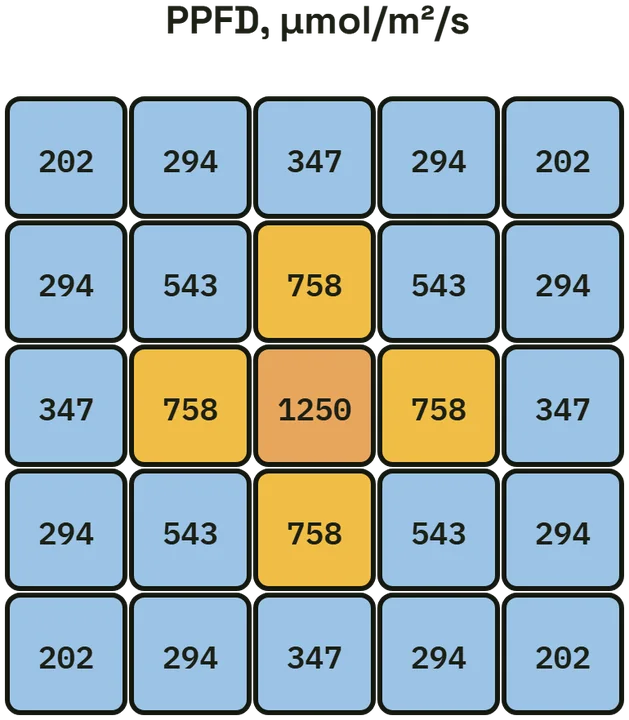
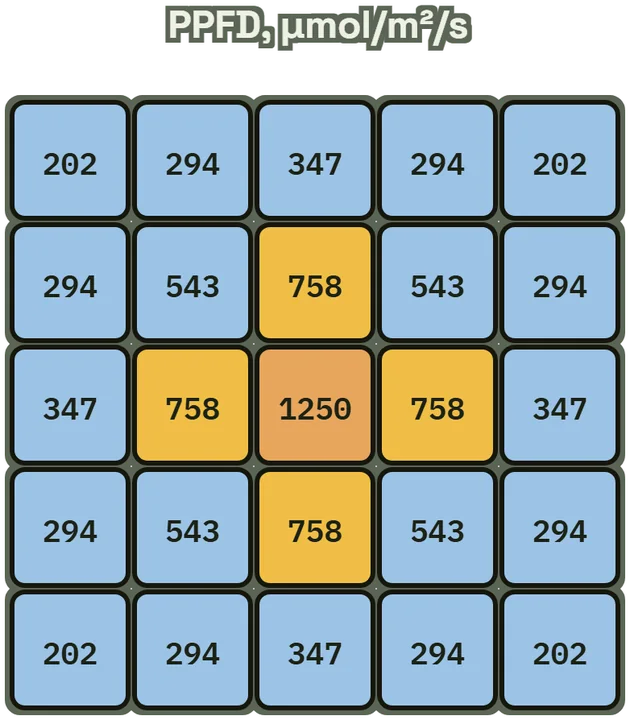
Worked example, 4 × 4 tent, 9-point grid: centre 1,150; four mid-edges 950; four corners 650. Average = (1,150 + 4 × 950 + 4 × 650) ÷ 9 ≈ 840. Uniformity = 650 ÷ 840 ≈ 0.77. Good.
Ways to improve it:
- Raise the fixture a little (wider spread), then turn it up to restore the average.
- Use more, smaller fixtures or bars instead of one central panel.
- Keep reflective walls clean and tight; close gaps.
- Train the canopy flat (SCROG, LST) so every top sits at the same height.
- Avoid stacking plants in the corners where light is weakest.
Poor uniformity costs grams: the centre gets more than it can use while the edges grow small, airy buds.
The house recommendation: oversize, then dim
GenetixBay's house position: oversize your lighting and dim it down, rather than underlight. In the founder's words: "I'd rather have 50 watts a foot or even more that I can dim down (too much is better than not enough), and can always raise intensity until saturation limits are reached." Many buying guides suggest half that or less, and the results, especially with cheaper panels, let newcomers down (founder's field experience) [8].
The target: about 50 W/ft² of dimmable LED capacity (about 540 W/m²). For a 4 × 4 ft tent the founder recommends 800–900 W (about 50–56 W/ft²). You don't run it all at 100% all the time; you have it when the plants can use it.
Why the headroom pays:
- Dimming headroom. A fixture run at 70–90% runs cooler and lasts longer than one flat out (see the buyer-beware guide and LED drivers explained).
- Fixtures age. LED output fades over time, faster when hot or overdriven [4]; spare capacity lets you hold the target as it does.
- Budget panels underdeliver. If the fixture makes less light per watt than claimed, extra watts cover the gap (see the bin and drive-current math).
- Edges and corners. Running a bigger array lower in power spreads light more evenly than pushing a small one hard.
- Room to grow. As the plants and the grower improve (CO₂, climate, feeding), you can raise intensity instead of buying more lights.
4 × 4 ft example, 50 W/ft² = 800 W at the wall of a mid-tier 2.6 µmol/J LED (85% of photons on the canopy, assumed):
| Dimmer setting | Average PPFD (µmol/m²/s) | Good for |
|---|---|---|
| 25% | ~300 | Seedlings, fresh clones |
| 50% | ~595 | Veg |
| 75% | ~890 | Flower, ambient CO₂ |
| 100% | ~1,190 | Late flower with CO₂ and climate to match |
A top-tier 3.0 µmol/J fixture at the same 800 W reaches about 1,370 at 100%.
- ~30025%: seedlings and clonesµmol/m²/s
- ~59550%: veg
- ~89075%: flower, ambient CO₂
- ~1,190100%: late flower with CO₂ and climate to match
Source: 800 W × 2.6 µmol/J × 0.85 ÷ 1.49 m², this guide's formula.
How to ramp it safely:
- Start dimmed: about 25% for seedlings and clones, about 50% in veg.
- Raise PPFD in steps of about 10–15% every 3–5 days, measured at the canopy.
- Watch leaf temperature (IR thermometer) and leaf VPD at each step; under LED, leaves run 1–3 °C cooler than air (see LED room temperature).
- Back off at bleaching, tacoing or leaves that stay praying upward (see heat and light stress).
- Push toward the saturation range only with CO₂ and climate to match. In the best indoor trial, yield was still rising linearly at about 1,800 µmol/m²/s at ambient CO₂ [1], and cannabis photosynthesis rises further at high light when CO₂ is raised [9] (see CO₂ enrichment).
The honest caveat. More light is only useful if the rest keeps up. Every extra watt is 3.412 BTU/h of heat to remove; more photosynthesis means more water transpired, so more dehumidification; and high light needs CO₂ and feeding to match. Size them with the AC, dehumidifier, CO₂ and electrical guides, or the calculators.
Is 800 W in a 4 × 4 overkill? What the science says
No. More light = more yield. Simple as that (the founder's rule) [8]. The common advice of 240–400 W for a 4 × 4 ft tent can work, but cannabis can use far more light than most growers give it, and th## Is 800 W in a 4 × 4 overkill?
No. In a controlled trial, cannabis yield rose in a straight line up to about 1,800 µmol/m²/s with no loss of potency [1], and 800–900 W of good LED in a 4 × 4 only reaches about 1,200–1,450. More light = more yield is GenetixBay's house position (founder's field experience) [8], provided the cooling, CO₂, climate and feeding keep up. The full case, the 240–850 W comparison, the PR zone at 1,800–2,200 µmol/m²/s and the downsides are in More light, more yield: is 800 W in a 4 × 4 really overkill?.
ise and sunset ramps at their real PPFD, not at full power.
Common mistakes
- Sizing by watts instead of light. 600 W of a budget panel and 600 W of a top-tier LED are very different amounts of plant food [2][3].
- Using the box's "equivalent" watts or a centre-point PPFD reading over a smaller area than your tent.
- Underlighting after switching from HPS to LED. A "240 W replaces 400 W HPS" panel in a 4 × 4 gives about 410 µmol/m²/s: veg light, not flower light. In the founder's experience this is common: growers used to be limited by HPS heat and never raise the watts once that limit is gone [8].
- Forgetting the corners. A great average with dark corners still grows uneven buds.
- Hanging by a fixed distance from a forum post instead of measuring.
- Pushing past about 1,200 µmol/m²/s without CO₂, healthy roots and good climate, then blaming the cultivar.